Reimagining Sustainability Reporting and Business Ethics: Teaching with Sustainability Cards
by Anna Vysotskaya, University of Surrey
Sustainability has risen to prominence in public discourse over recent decades, providing a crucial lens for evaluating contemporary challenges and decisions across the world and industries. Embedding it within a technically focused accounting curriculum (especially across large cohorts) can, however, be challenging.
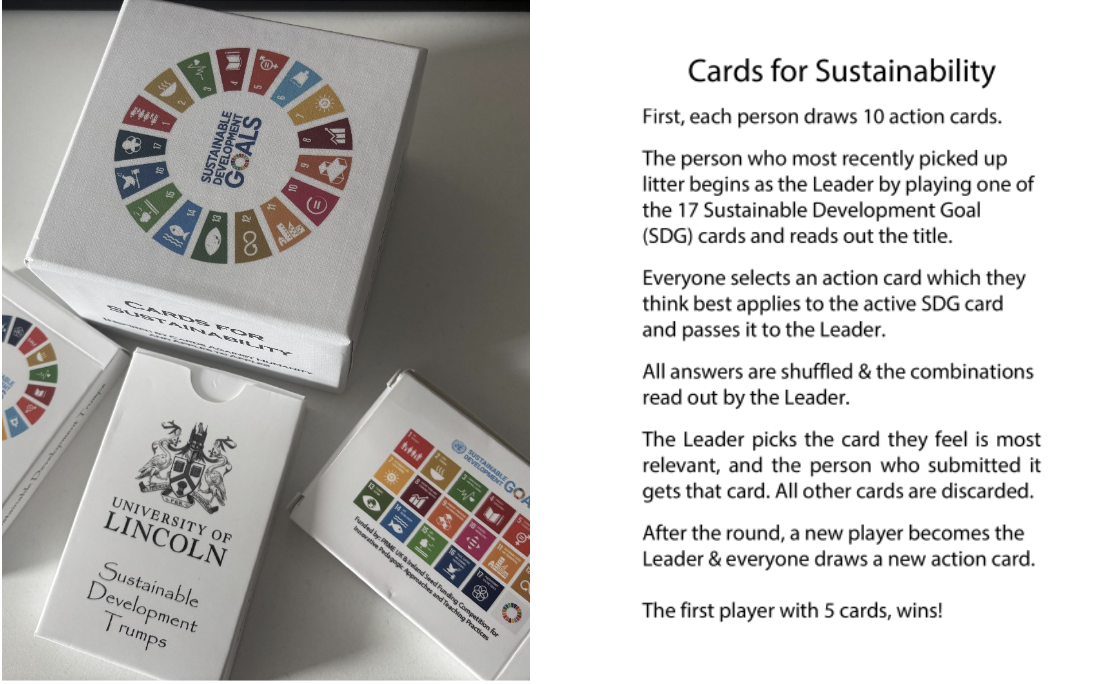
This blog presents a practical response: Sustainability Cards deployed in the Sustainability Reporting and Business Ethics module. On reflection, the approach delivered measurable gains in student engagement and a notably richer learning experience.
Why Sustainability Cards?
Many educators believe that using playing cards in the educational process can make accounting subjects more engaging and meaningful (Lázaro-Gutiérrez, et.al., 2017). At the same time, Sustainability is reportedly considered to be an important lens through which accounting courses should be taught (Cam and Ballantine, 2025; Tran and Herzig, 2023; Cho and Costa, 2024), i.e., related to traditional accounting concepts such as performance measurement, reporting, and assurance. Integrating sustainability into teaching promotes holistic decision-making, ethical awareness, and accountability, aligning with global frameworks, i.e. the UN Sustainable Development Goals and the International Sustainability Standards Board (ISSB) standards.
Furthermore, embedding sustainability themes across modules (e.g., management accounting, corporate reporting, audit) enhances students’ ability to critically evaluate the long-term impacts of business activities, preparing graduates for contemporary professional practice and meeting expectations outlined in QAA Subject Benchmark Statements and Professional, Statutory and Regulatory Body (PSRB) guidance. In 2024, an initiative led by my colleagues Davina Bird and David
Anderson at University of Lincoln, UK was successfully implemented with support from the PRME Chapter UK & Ireland Innovative Pedagogy Competition, which enabled the design and production of sustainability cards. Within the educational pack developed, the customised card decks were professionally printed for durability and reuse. The authors also provided base game copies for group activities in seminars. The cards* are versatile and can be integrated into any subject area or academic level. With Davina’s and David’s invaluable support in bringing this idea to life, these cards were presented to students along with real-world scenarios that challenged them to apply sustainability reporting principles to pressing environmental and social issues.
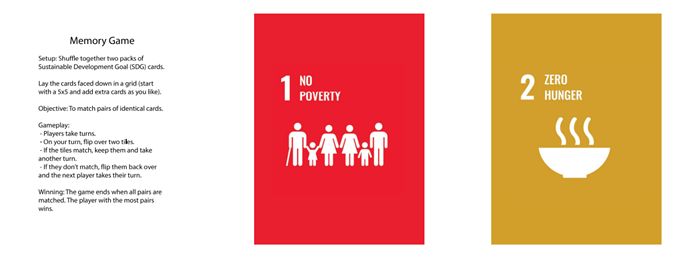
In doing so, this activity not only enhanced critical thinking and problem-solving skills but also helped students see accounting as a tool for positive change.
Making Sustainability Reporting Relevant
What was noticed is that by connecting sustainability concepts on cards to real-world sustainability reporting challenges, such as carbon emissions, ethical sourcing, and social equity, students began to understand the broader implications of financial decisions. The cards helped to bridge the gap between theory and practice, making their learning experience more relevant and compelling.
To ensure maximum impact, we carefully selected scenarios that were both realistic and directly applicable to the accounting principles covered in the module. This alignment has significantly boosted student engagement and sparked deeper classroom discussions in a diverse classroom. One key observation is that while the Sustainable Development Goals (SDGs) are often displayed on screens and featured in presentations, this approach is less impactful than providing students with tangible, interactive experiences that allow them to connect the goals to real-world scenarios.
Dialogue, Debate, and Deeper Learning
The cards also proved to stimulate group discussions and debates on the role of SDGs in accounting in promoting sustainability. When introduced to a group of around 50 international postgraduate students, the Sustainability Cards immediately captured attention, sparking curiosity as students explored the scenarios printed on them. The activity began with short case studies displayed on screen, prompting students to select the corresponding SDGs from their cards and explain their choices. These conversations led to powerful insights about the ethical dimensions of financial reporting and the responsibilities of future professionals in shaping a more sustainable world.
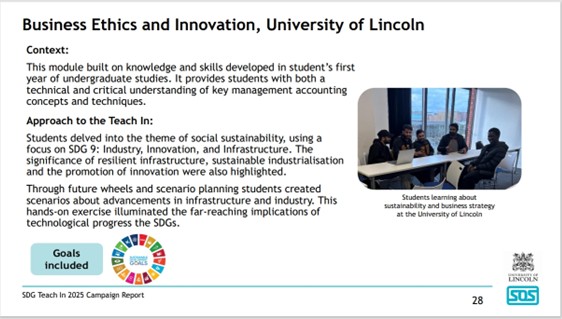
While we integrated sustainability cards into Sustainability Reporting and Business Ethics module as part of the PRME initiative, this practice was reflected in the University of Lincoln’s contribution to the Global Goals Teach In (SOS-UK, 2025), an annual campaign led by SOS-UK to embed the UN Sustainable Development Goals (SDGs) into education.
Toward a Holistic Understanding
We found that Sustainability cards presented students with real-world scenarios that challenged them to apply sustainability reporting principles to environmental and social issues, fostering critical thinking and ethical awareness. Used to spark group discussions and debates, the cards helped students explore the role of accountants in advancing sustainability, aligning directly with SDG 4 (Quality Education), SDG 12 (Responsible Consumption and Production), and SDG 13 (Climate Action). This approach not only enhanced student engagement but also supported the campaign’s mission to embed sustainability across disciplines and prepare learners to tackle global challenges. Thus, the goal of integrating sustainability cards into the Sustainability Reporting module is to foster a more holistic understanding of accounting, one that highlights its potential to drive ethical, environmental, and social progress. By equipping students with the tools to think critically and act responsibly, we’re not just teaching them how to report on sustainability; we’re helping them become part of the solution.
Observing a Positive Shift in Student Performance
One of the most encouraging outcomes of integrating sustainability cards into the Sustainability Reporting and Business Ethics module has been the marked improvement in overall student performance compared to previous cohorts. In the most recent academic year, we observed a significant decrease (from 27% to 8%) in failure rates versus 2023–24. The overall pass rate rose to 81%, a notable improvement from the previous cohort’s 69%. Assessments were not changed.
Evidently positive student engagement and results suggest that the interactive, scenario-based approach not only enhances engagement but also supports deeper understanding of complex accounting and sustainability concepts. By encouraging critical thinking, ethical reasoning, and collaborative problem-solving, the cards appear to foster more meaningful learning experiences, reflected in both student feedback and assessment outcomes.
*The cards are available through the Teaching Resources from the Innovative Pedagogy Competition, each educational pack includes customised cards, base game copies and teaching support materials (Innovative RME Teaching Resources | uki-prme).